Supermarket Savings
It's the SuperSaver Club, Everyone!
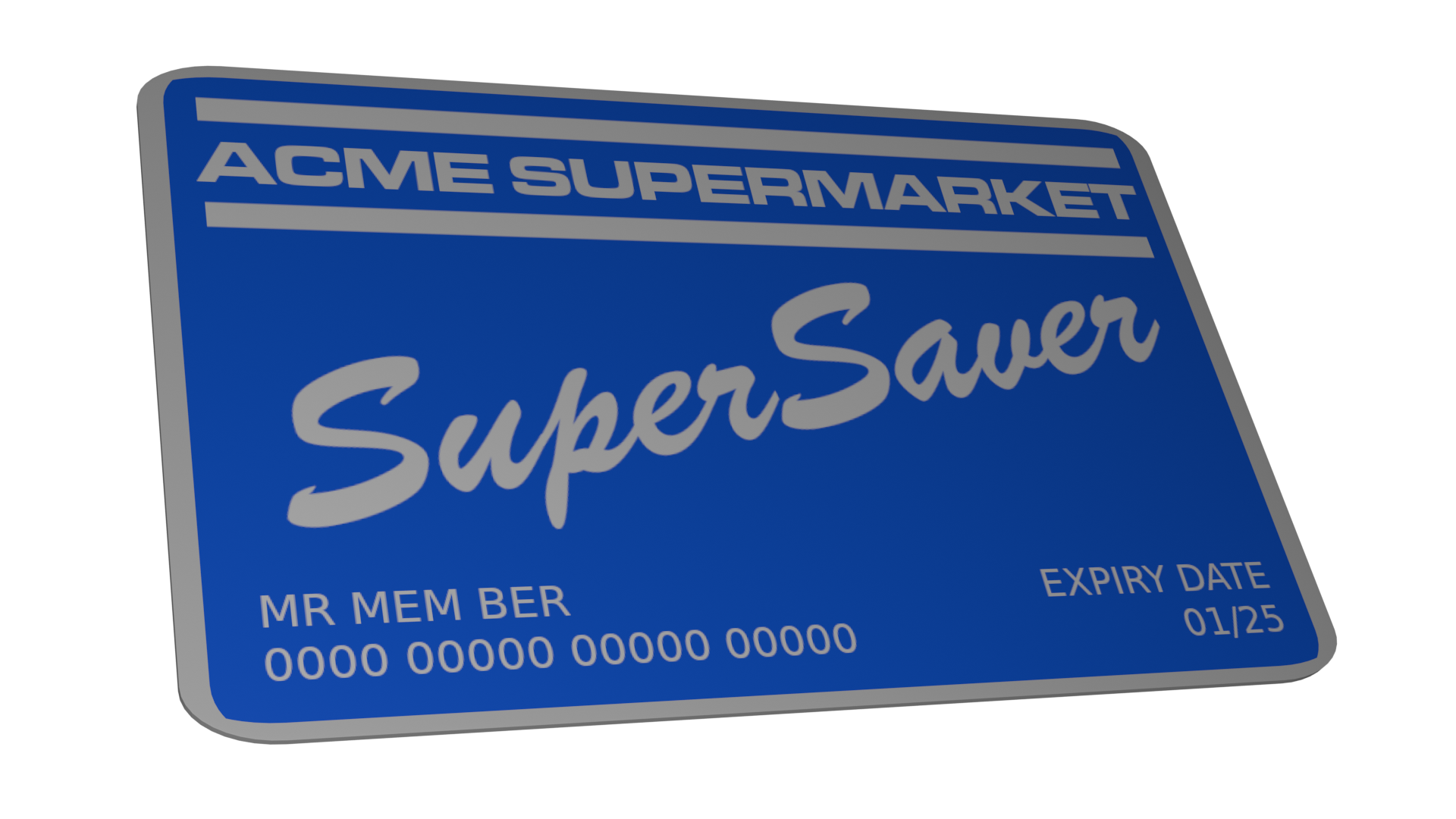
The Acme Supermarket SuperSaver Club membership card!
Want to get ahead as a supermarket? Then read on.
Enter the 'SuperSaver Club'.
This is a scheme that will have customers—and potential customers—think they're getting discounts on your products while you, the supermarket operator, gain personally-identifiable customer shopping data and increase not only your turnover but profits and margins, too.
Before you introduce the scheme you first have to jack up the prices of your products.
Now it's launch time. I'm calling the scheme the 'SuperSaver Club' just for the sake of example.
The scheme involves inviting shoppers to become members of the
SuperSaver Club. Any who do will be given a SuperSaver Club card, a
plastic card the same size and format as traditional credit/debit cards
and/or a virtual card, accessed through a smartphone.
When a customer pays at the till and scans their SuperSaver Club card, they get the 'discount' or 'discounts' on their shopping.

Acme Supermarket's SuperSaver Club dual pricing—use the SuperSaver card to get the 'discounted' price on the product
The card identifies the customer personally because, to sign-up to the scheme, you have to give personal details such as your name (and address so that the plastic card to be sent to you), and each card has the member's unique membership number stored on it.
Benefits of the scheme:
- Shoppers join the Club as they can see they will get a 'discount' on their shopping;
- Turnover is increased as shoppers are tempted to spend the 'savings' on extra products, products they wouldn't otherwise be buying;
- The supermarket gets very valuable data about each shopper, meaning product-marketing to them can be personally-tailored;
- Although members are 'getting a discount', the supermarket isn't losing out because the 'discounted' prices are the prices the supermarket would be charging if it hadn't introduced the scheme, in other words, the prices it was charging before the scheme was introduced and would be continuing to charge now;
- But not only is the supermarket not losing out; it's actually gaining in terms of its profit margin. That's because not every shopper will be shopping as a Club member, for example, shoppers who haven't heard of the scheme, people who have but don't want to join it for whatever reason (such as not wanting their shopping habits known to the supermarket and/or being wealthy enough to not care about getting a 'discount'), those without their card/phone because of its being lost or stolen, or it simply having been left behind somewhere;
- Although introducing and running the Club costs the supermarket money, particularly the initial setting-up, costs are at least partly offset by the extra profit made from shoppers who shop without being a member or who are members but are not using their card (see example reasons, above) and are thus paying the inflated, non-'discounted', prices of products.
Supermarkets who deploy these schemes are not breaking UK law, nor contravening any other UK rules or regulations. However, there's the question of transparency in terms of shoppers' awareness of what's really going on here; one actual supermarket chain's TV advertisement depicts the shopper as having 'the power to lower prices', which is disingenuous: the only people able to lower prices are the managers of their stores, subject to any superordinate authority.
Also, there's the issue of the greater pressure likely felt by poorer shoppers to join and utilise these schemes, thus be giving over data about their shopping habits, as they're less able to afford to pay the non-scheme, higher prices, especially given that essential products, such as foodstuffs, are involved.
Any similarities to any actual supermarkets, schemes , cards or merchandise are entirely co-incidental.