[SITE UNDER CONSTRUCTION AND TESTING.]
Middlesbrough
The Late-August, 2026 Criminality
Events, the Town's Deprivation, and Outsiders' Reactions
Middlesbrough is the name of a town and the borough in
which it sits in Teesside, a part of the wider Tees Valley area within the
north-east England region of Britain. Of those Brits never having had
anything to do with the town, ie the vast majority of the country's
population, familiarity with the name will almost exclusively be held by
football fans paying attention to sports journalism and hearing its
namesake team mentioned. Outside of this, it almost never gets a mention,
let alone attention, and that includes by the UK Government and national
mainstream media. Indeed, the same applies to the Teesside area, the name
often mis-spelled even by mainstream news journalists—there's no River
'Tee' in the UK, so there's no 'Teeside' either (thinking of you,
Guardian/Independent). Even the entire north-east goes unremarked. But,
then again, the North of England apparently stretches up only as far as
Manchester/Liverpool.
This past week, a serious incident occurred on the A66
dual carriageway not far from central Middlesbrough. Five young local men
were killed instantly when the car they were in, driven at speed the wrong
way along the road in an attempt to escape a pursuing police car, collided
with another police car, killing both officers, that was approaching in
the opposite, correct direction. It was later revealed that all but one of
the men in the car traveling in the wrong direction, the vehicle bearing
cloned number plates, had previous criminal convictions. For me, at least,
this does not diminish the tragedy of the incident. Those five lives were
lost. The two police officers lives were lost. Lives were lost.
Unsurprisingly, and quite rightly, mainstream media
coverage was national. As were follow-up reports of reactions, including a
deployment of two hundred police, drawn from all over the country
(Cleveland Police, despite the high crime statistics of the area policed,
is one of the UK's smallest forces), brought in to investigate other
incidents in the town that followed, relationships to be established, and
enhance deterrence, providing assurance and a sense of safety to the
community at large.
On Friday, 28 August, 2026, two hundred miles due south
of what locals refer to as 'the Boro', a studio of London-situated but
nationally broadcasting phone-in radio station LBC was being geared up for
the James O'Brien show (10am–1pm, weekdays), so I tuned in to experience
the expressed musings of the longtime-capital-living presenter, and those
of the general public country-wide. Contributors suggested various causes
of the spurt in Middlesbrough criminality, in response to which O'Brien
rightly stated that those underlying conditions existed in other towns,
pressing the question as to what it was that was different about this
particular town compared to those others. Astonishingly, one caller
suggested that the acute rise in lawbreaking was simply something that
happened to various places at various times; this year it's Middlesbrough,
next year it'll be another town instead, the year after, somewhere else.
As if there were some or other wandering force, periodically going about
and randomly picking on locations around the country, like the National
Lottery 'finger from the sky' commercials, Lady Luck flying through the
ether to turn Lotto players into winners; last week it was a 'Fred' in
Barnstable, this week it's a 'Sheila' in Kent, the next week's yet to be
decided. To answer the question 'What's different about Middlesbrough?':
it's about DEGREE. Middlesbrough's chronic problems originated decades
ago, and, to reiterate, have remained largely ignored by national
government, and rarely acknowledged in the mainstream media, outsiders'
solutions absent any knowledge of its history.
I remember the Sun newspaper talking about 'a small
town in Europe', the sentiment inferring a reading of 'just a small
town'. I also remember the newspaper's back page main sports headline,
'MIDDLESBROUGH IS A DUMP', football fans of a southern rival team having
traveled to the town for an away match and voicing their opinion of the
place, the incongruity of the local team's new Riverside stadium set,
lonely-looking, in the barren, otherwise-undeveloped wasteland of the
town's St Hildas area, later, ironically, re-named 'Middlehaven', given
'haven' defined as a tranquil place of beauty, with only the small and
long-left-abandoned original town hall, that anywhere else would be
well-maintained and shown off as the historic monument that it is, to keep
it company. I suppose the 'dump' headline could be taken positively, 'the
best disinfectant being sunlight', as the saying goes, spotlighting to a
wider audience the state of the place, to hopefully precipitate
investment. Of course, it could just as well have the opposite effect,
perpetuating a vicious cycle of deprivation → bad reputation → fewer
visitors/investors → weaker economy → continuing deprivation → worse
reputation.
O'Brien acknowledged the fact that the town had thrived
on its iron- and steel-making industry, for example, Australia's Sydney
Harbour Bridge was designed and built by the Dorman Long company, 'Made in
Middlesbrough' stamped on the structure's side. But, as the caller pointed
out, that, and thus the thousands of jobs such industrialism provided,
disappeared a long time ago. Others, representing predominantly the
political right, ignored the symptomatic nature of the criminality: just
send in the cops and crack down on misbehaviour and crime; "Lock 'em up
and throw away the key, and if and when the jails are full, build some
more". Of course, law enforcement, deterring crime with the threat of
discovery, conviction and punishment, including jail time, is legitimate,
but on its own, at best, all it usually does is take some of the
wrongdoers off the streets for some of the time, leaving precipitant
environmental factors untouched, left to mis-shape the next generation.
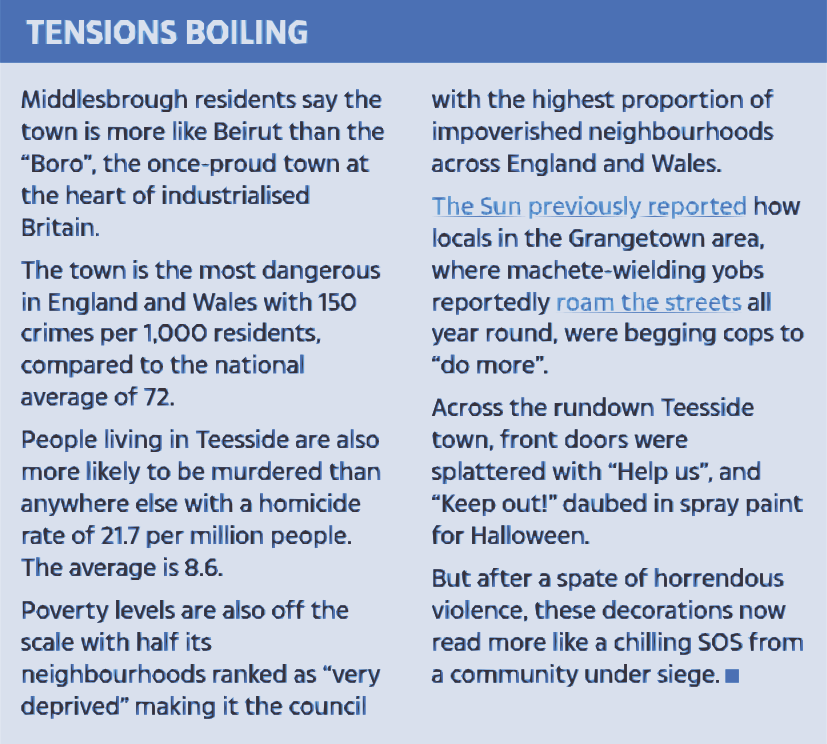
Middlesbrough's stats, reported in the Sun and
elsewhere, are especially notable:
Screenshot of a Sun
newspaper article detailing Middlesbrough stats
Source: https://www.thesun.co.uk/news/40198626/yobs-rule-streets-middlesbrough-locals-blast-gang-war/
Locally, it's not like solutions haven't been tried.
Take redevelopment, for example. Over many years, various, sometimes
grandiose, dreamed-up ideas have come and gone, including proposals to
turn the aforementioned Middlehaven site into a bizarre, futuristic mix of
brightly multi-coloured housing and commercial properties, including
cubist, cantilevered homes and a hotel shaped like and representing a wine
glass. I'm sure I wasn't the only one to get the impression, rightly or
wrongly, that these were no more than playful musings by some or other
bunch of architects merely idling away a lazy Sunday afternoon. More
modest, traditional-format-but-modern-styled constructions have been
proposed, such as a high-rise block intended to be worked in by digital
creatives. A few years back, there was a proposal for an indoor artificial
ski slope. None of the above progressed beyond artists' impressions stage.
I can't be the only one to have grown weary of headlines in the local
newspaper, the Gazette, declaring: 'Plans for a [insert description of
proposal] drawn up', sometimes followed by: 'that could result in [insert
number] new jobs'. Reader comments are often overwhelmingly negative, 'pie
in the sky', being an example. A plan for a retail park was planned for
Middlehaven, which included building and operating a large Iceland
supermarket. An established nearby branch of the major supermarket chain
Sainsbury's was planned to relocate there, and it did get fully built,
only for the company's bosses to then abandon it, the gleaming buildings
thus standing eerily silent and empty, its spotless shelves unstocked (if
I remember correctly, it did, however, prove temporarily useful as a scene
in a dystopian movie). I think the reasons were partly because of other
grocery stores' opposition to a proximate, rival competitor, partly
because of its relative remoteness from the town centre, and partly
because of the vicious circle of tenants' doubts about each other's
commitment to the project, given the intrinsic likelihood of members of
any business park riding in the 'slipstreams' of each other's footfall.
For many projects, it's a case of either that the money to back up
proposals wasn't there, was but realities had set in by the time it came
to signing the cheques, or the illustrated proposals were just a kind of
dog-and-pony show all along, to give the local paper something to write
about, and give the town's residents a reason to be cheerfully optimistic
about. The latest proposal for Middlesbrough's Middlehaven and town centre
areas amounts to a copy-and-paste of what neighbouring town and borough
Stockton-on-Tees' council came up with, secured the finances for,
including investment from private developers and construction firms, and
has just this year completed for its own town centre and adjacent
environs, all of which widely deemed a success: a modern housing estate
(North Shore); an urban park (the Waterfront); a state-of-the-art theatre
(restoration of the historic Globe); and a hotel (Hampton by Hilton, a
franchise operation). I'm not so sure about Middlesbrough's idea for a
theatre, two significant and mutually-proximate chasing the same
population of theater-goers could diminish them both, even if and when
operating inter-contrasting playbills.
Overwhelmingly, these schemes are very much thought up
by local politicians, such as the town's mayors, or the local council and
their town planning department, rather than business people, such as
commercial developers. Council's spending of taxpayer's money even to fund
the groundwork for schemes, unsurprisingly, attracts a lot of scrutiny
from the electorate, often proving controversial, opposing arguments along
political lines. Divided opinion stalls projects, politicians unwilling to
gain votes from one side only to be lost from the other. And, when it
comes to public money, unsurpringly its councils responsible for
administering a poverty-stricken area that have the least money to spend
improving it; Middlesbrough Council was recently at risk of effective
bankruptcy, the area having such a large proportion of residents heavily
dependent on council resources, such as social services.
Middlesbrough neighbours two other towns and boroughs,
namely Stockton-on-Tees, and Redcar, its borough called 'Redcar and
Cleveland'. All three are what make up the conurbation that is Teesside,
the eighteenth-largest urban area in the United Kingdom (2011 stat).
Together with nearby Hartlepool and Darlington, these five towns and
boroughs make up the wider Tees Valley area.
One interesting difference between Middlesbrough and
its Tees Valley neighbours occurred back in the summer of 2024. A number
of riots broke out across England and Northern Ireland. English Wikipedia
summaries the background to them:
From 30 July to 5 August 2024, far-right anti-immigration protests and
riots occurred in England and Northern Ireland, within the United
Kingdom, following the 2024 Southport stabbings, a targeted stabbing at
a dance class in Southport, England on 29 July 2024 which resulted in
the deaths of three young girls. The riots took place amid false claims
circulated by far-right groups, that the perpetrator of the attack was a
Muslim and an asylum seeker, in addition to broader Islamophobic,
racist, and anti-immigrant sentiments. The disorder, which involved
racist attacks, arson and looting, was the largest incident of social
unrest in England since 2011. By 8 August, at least 177 individuals had
been imprisoned in connection to the unrest, with sentences averaging
around two years and ranging up to nine years. The following month,
1,280 arrests and nearly 800 charges had been made; as of July 2025, the
numbers of arrests and charges stand at 1,840 and 1,103, respectively.
On the afternoon of Sunday, 4 August, one of the towns
in which the rioting occurred was Middlesbrough. However, at the exact
same time that that was taking place there, in stark contrast, just across
the River Tees, in neighbouring Stockton-on-Tees, people from all ages,
backgrounds, races and cultures were enjoying the fourth and final day of
that year's long-scheduled, decades-running, free annual Stockton
International Riverside Festival (SIRF) of family entertainment and arts,
including a community carnival, made up of volunteered locals, and
performances, including street performances, of artists similarly diverse,
from all over the world. (This year, Stockton-on-Tees has been shortlisted
out of nearly 400 total applications as one of 15 finalists for the
inaugural 'UK Town of Culture 2028' title.) There were no disturbances,
let alone riots, in Stockton-on-Tees. Now, although the town and borough
of Stockton overall does not exactly rank quite as high as Middlesbrough
for deprivation and criminality, it's not impossible that, were the
festival not to have been happening to coincide with Middlesbrough's
rioting, at least some level of disturbance could have occurred in
Stockton, but note that, setting Middlesbrough and Stockton aside, of the
other, three, neighbouring boroughs: Darlington; Hartlepool; and Redcar
and Cleveland, only Hartlepool experienced significant disturbances
(Wednesday, 31 July, 2024 (prior to the Middlesbrough riot on 4 August),
resulting in several arrests, officers injured, and a police car set on
fire).
This is not to say that Middlesbrough is a xenophobic,
racist town, nor that neighbouring ones are bastions of inclusion and
respect.
Indeed, spanning the weekend of 7/8 August, 2024, the
thirty-fourth Middlesbrough Mela, a free, annual two-day multi-cultural
festival based on the originating Indian model, successfully took place in
the town, kicking off—in the positive sense—just over a month after the
rioting, featuring a range of musical performances, family-friendly
activities, and food from across the multi-cultural spectrum.
And, not all of those participating in the unrest
necessarily represented hardened criminality. The sight of a young
teenager entering an already-broken into and -looted Greggs, emerging with
a tray of sausage rolls, a triumphant grin on his face, but having made no
effort to hide his identity might suggest naïve, opportunistic
mischievousness as much as a determinedly brazen disregard for social
norms and the law.
Middlesbrough is not "full of bad people". There's no
such thing as a 'bad' person; people aren't immutably hard-wired to be
bad, good, neither nor anything in between. With the possible exception of
those having certain organic or traumatic brain disorders, there are
simply people who have done, or are doing, bad things, even if that's what
they've been doing most of their lives. But that's not the same thing as
someone being 'a bad person'. People can change. And people are shaped by
their environment, especially in formative years (childhood). I recall
broadcast interviews of highly successful, very wealthy people, often
business people, who grew up in an impoverished environment, the family
struggling to scrape by. I heard them talk about how those circumstances
sparked a determination in themselves to get out and make something of
their lives, so that they'd not have to endure such deprivation again. The
inference was that everyone could easily 'pull their socks up' and do well
in life. But not everybody gets that spark inside them, In fact, I would
guess that at least as many people living in poverty, especially in
childhood, are as likely to feel demotivated, thinking that "this
is how its meant to be for me", "What's the point in trying?", and/or
being groomed or seduced, or otherwise become fallen into the unwholesome
ways, perhaps criminal ways, of those already in such emotional and
psychological spaces.
There is hope, and it doesn't come from simply blaming
the victims and survivors for the environment in which they live, having
no power to change it, and instilled with little motivation to relocate,
assuming it would be reasonable to expect that they do so. I'm sure the
five young people who died in the car crash could have had, or gone on to
have, lawful and fulfilling lives. As Andy Preston, former Mayor of
Middlesbrough pointed out: when he was a teenager, in the 1970s, there
were youth clubs to go to. They since became rare, victims of local
authority cut-backs as they're not services statutorily mandated, yet can
play such an important part in shaping young hearts and minds. The young
men killed in the crash will have had positive talents and potential that
now go unfulfilled. Things could have been so much better for them.
Solving Middlesbrough's issues is
urgent, but the question is: This time, will it be the
same-old-same-old, or what's actually needed?